Find us at PORCH: An Architecture of Generosity, the 2025 United States Pavilion at the 19th International Architecture Exhibition. Visit the Biennale page for more.
Phoenix is often described as a transient place—a city people pass through rather than root into. But beneath that reputation lies a deeper story: the mountains, waterways, and plant life that have shaped this valley for millennia, and the human cultures who have called it home. That deeper story became the foundation for the transformation of 100 West Washington, the brutalist, International Style tower built in 1971 as the First National Bank building. Later known as the Wells Fargo Tower, the City of Phoenix purchased it in 2016 to become the centralized headquarters for the Phoenix Police Department. Completed in 2025, the project brought the department’s most critical functions—a 911 call center, a Real Time Operations Center, a news briefing room, public-facing services, and police training facilities—under one roof, in service of the city’s commitment to community-led policing.
The building runs a full city block, from City Hall’s plaza to the highly visible corner of First Avenue and Washington Street. Its zero-setback siting and glassy ground-floor workspaces created a real tension: a facility built to house mission-critical operations, wrapped almost entirely in glass. A threat analysis called for three layers of protection at street level: security screening at the glass for visual privacy and vandal resistance, anti-ram bollards at the street corners, and anti-ram deterrents along key lengths of the building’s footprint. Jones Studio, serving as public art designer, joined architect Arrington Watkins and security consultant Richärd Kennedy Architects on the project team, tasked with fortifying that perimeter without losing the streetscape experience for the pedestrians and transit riders who pass by every day.
To find that balance, the design team began not with materials but with a feeling. Upon project kickoff, they asked police department stakeholders two questions: What makes you feel secure? What makes you feel serene? Across both questions, the answers kept returning to the same references: natural landscape, open space, protected boundaries. Those responses became the design concept for every security feature at the ground plane.
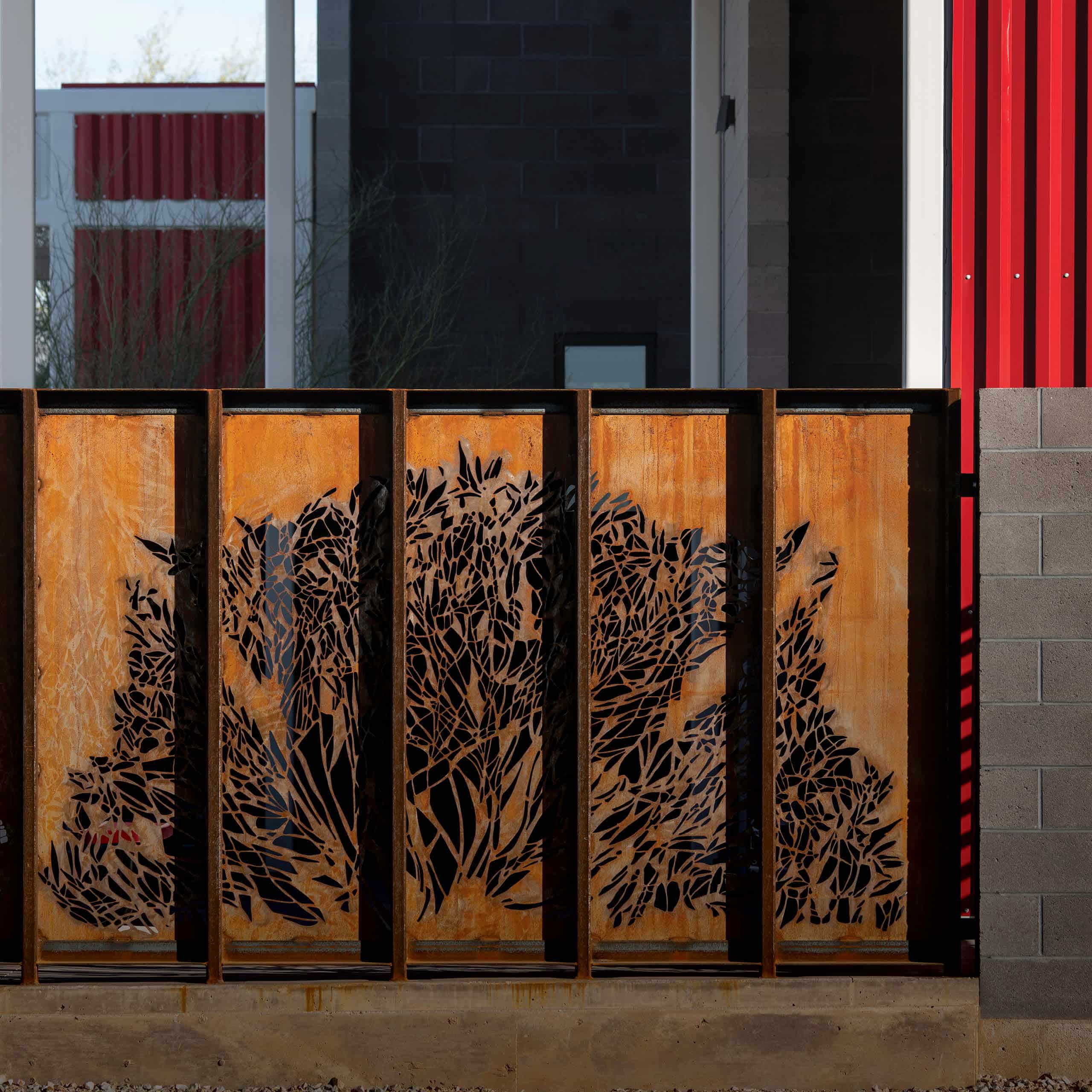
Considering Phoenix’s abundant open space, held on every side by its perimeter mountain ranges, the team illustrated the landmarks Phoenicians know by heart—Estrella Mountain, South Mountain, McDowell Mountain, and Piestewa Peak—etched onto a partially transparent security mesh that drapes the building’s glass-fronted workspaces. A copper-clad finish glows beneath the limestone-colored powder coat, forming a dramatic 325-foot-long backdrop to the streetscape. Giant granite boulders line that same stretch, heavy enough to serve as anti-ram deterrents while echoing the undulating mountain patterns etched above them—a literal, material link to the plants, rock formations, water, and animals of the Sonoran Desert the building calls home.
That sense of place didn’t come from the design team alone. Through a series of engagement workshops at Phoenix high schools, the team invited residents to answer a smaller, more personal version of the same questions. Their answers were translated into custom icons, and now live along the streetscape as hiking-trail-inspired markers—an impression not just of what each contributor saw, but of how they saw and thought about the world around them.
Together—the mountain drawings, the granite boulders, and the icons contributed by the community itself—the elements of 100 West Washington do more than secure a building. They gather the Valley’s many stories into one place as a quiet, ongoing testament to topophilia: a community’s enduring love for the ground it stands on.