Find us at PORCH: An Architecture of Generosity, the 2025 United States Pavilion at the 19th International Architecture Exhibition. Visit the Biennale page for more.
Public art at Fire Station #612 was conceived as both a cultural marker and a gathering place; an expression of identity that honors the lives of firefighters and their deep connection to the community they serve. At the intersection of city, desert, and mountain, the site itself embodies dualities: urban and wild, dry and verdant, dormant and flourishing. These contrasts became central to the design.
Jones Studio Senior Associate Maria Salenger led the art concept through an inclusive process of interviews and dialogue with firefighters from Station 602, Fire Chief Swick, and Assistant Chief staff. These conversations revealed recurring themes: family, team, courage, sacrifice, and an unwavering dedication to bettering community. Firefighters spoke of living with two families and two homes, their personal lives and their station lives, both inseparably interwoven. This notion of duality became a guiding principle for the work.
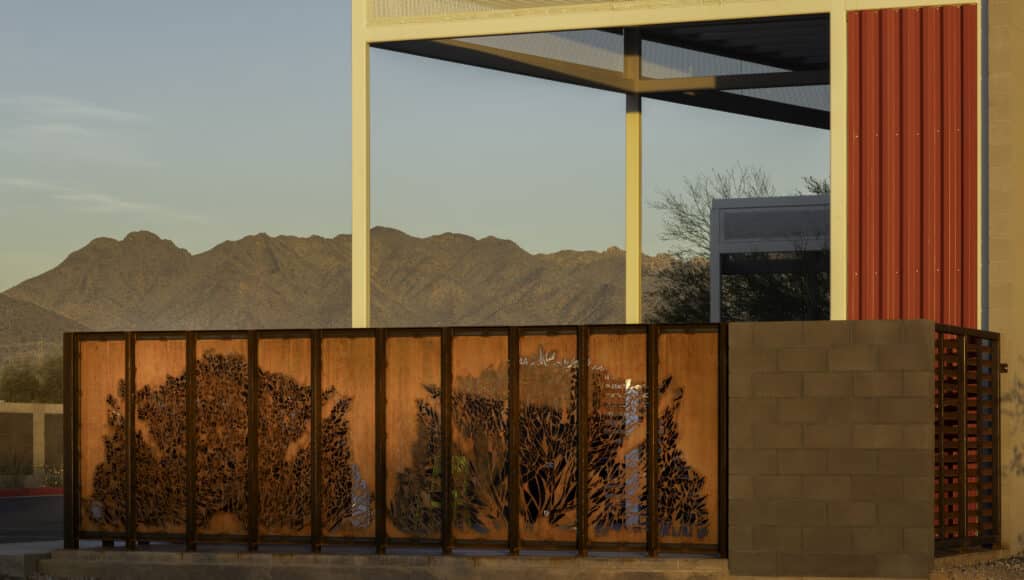
The design draws from the Maltese Cross, the universal emblem of firefighting that symbolizes protection and sacrifice. Historically, badges, trucks, and stations have been customized to reflect the spirit of the neighborhoods they serve. Building on this tradition, Maria combined the cross with imagery from the McDowell Mountain Preserve including native plants such as brittle bush, desert grasses, and seasonal blooms. Each species was carefully studied and translated into hand-drawn patterns, cut into steel panels to form the geometry of the cross’s petals.
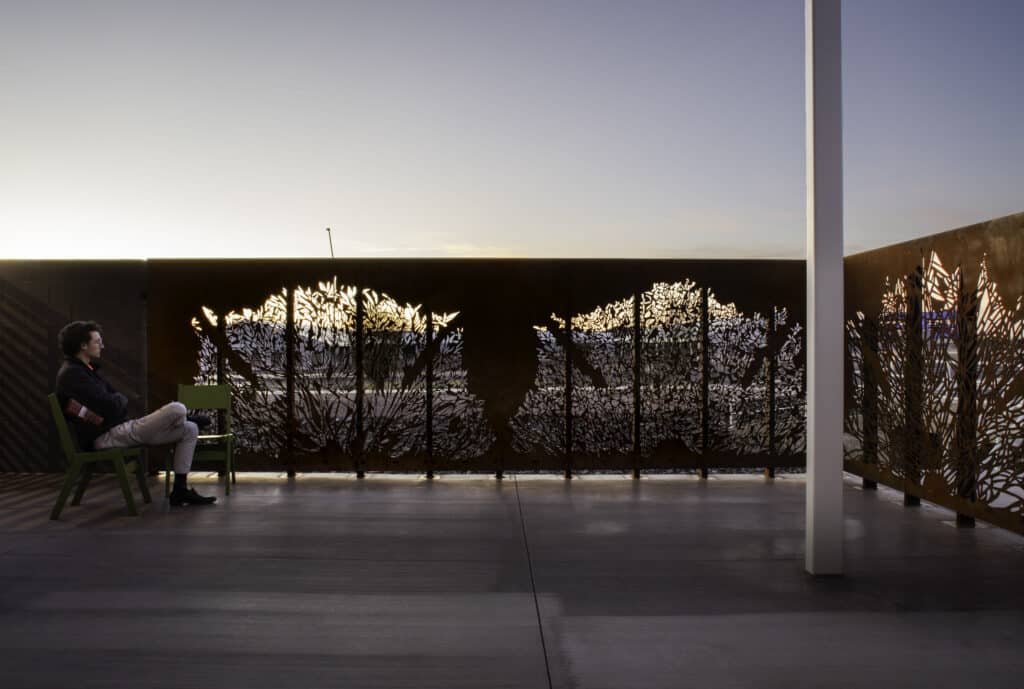
Installed as a screen wall along the north patio, the artwork transforms throughout the day as sunlight passes through its patterned openings. At times, shadows fragment across the ground and walls, evoking partial petals of the Maltese Cross. At other moments, light aligns to complete the emblem in full; a fleeting image of wholeness that reflects both the unity and impermanence of daily life. The dynamic interplay of shadow and structure honors the dual roles firefighters inhabit and the adaptability demanded of their profession.
Sun patterns were studied during different times of day and year to define the best location of the wall allow the maximum amount of sunlight to interact with the wall.
Functionally, the art wall anchors a flexible gathering space large enough to host events for the department, firefighters’ families, and the surrounding community. From Hayden Road, the patterned steel serves as a visible marker and wayfinding element for visitors approaching the station. From within, the kitchen and communal areas look directly out onto the wall, connecting interior life with the changing desert light outside.
The result is an enduring gesture: a work of art that is alive in time, responsive to its environment, and inseparable from the culture of those who call Station 612 home.